Stamped Concrete vs. Pavers: Best Choice for Dunedin Patios
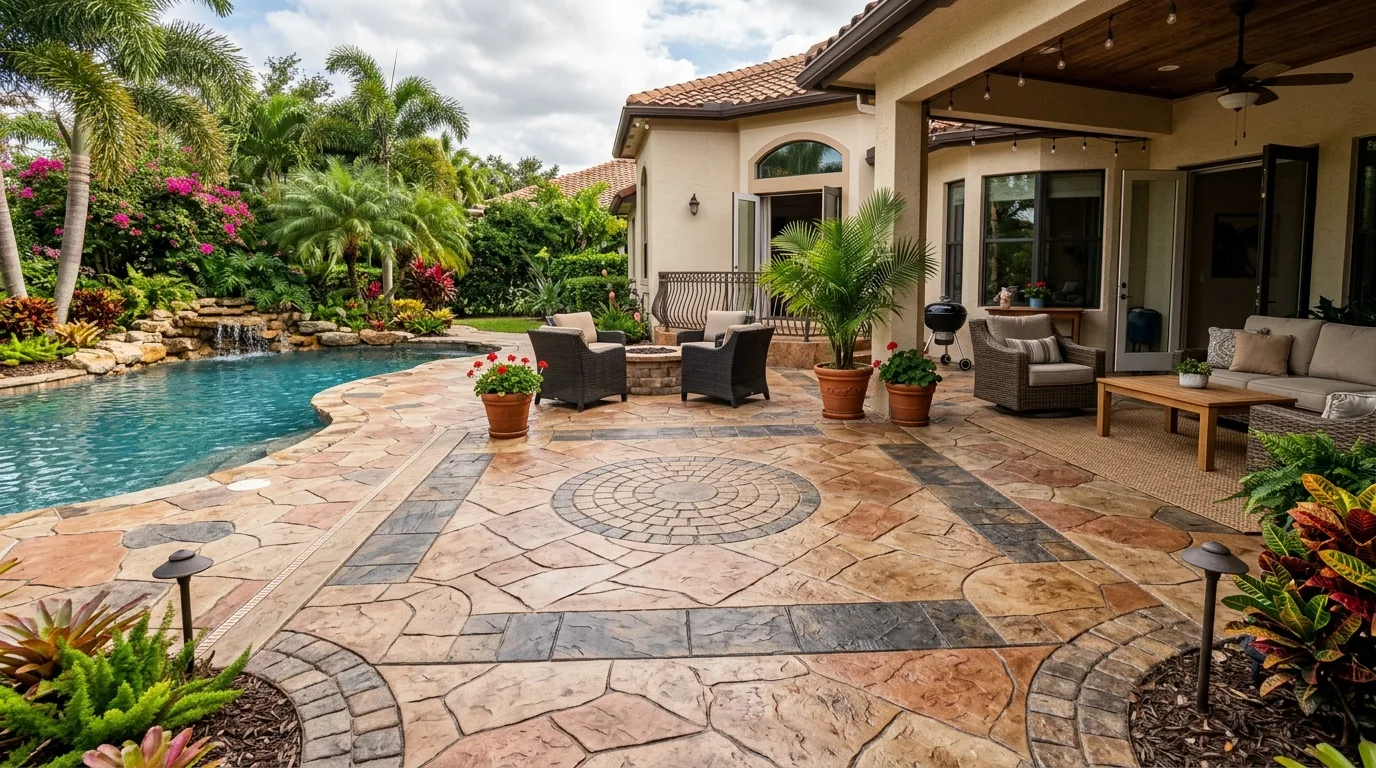
Is stamped concrete or pavers better for a Dunedin patio? It’s the most common question homeowners ask when planning an outdoor living upgrade, and the honest answer depends on four things: your budget, your maintenance tolerance, the size of the space, and how Pinellas County’s specific climate affects each material. This post gives you a complete side-by-side comparison so you can make the right choice for your property.
Get a Free Stamped Concrete or Paver Estimate in Dunedin
We'll walk you through both options and help you make the right choice for your outdoor space.
Why Dunedin’s Climate Changes the Calculation
Before comparing costs and aesthetics, it’s worth understanding why Dunedin’s climate affects this decision more than it would in a northern state. Pinellas County delivers roughly 52 inches of annual rainfall — most of it concentrated in intense afternoon thunderstorms between late May and early October. The ground beneath any patio surface goes through repeated wet-dry cycles that create movement in the sub-base. Additionally, Florida’s UV intensity is among the highest in the continental US, and the summer heat index in Dunedin regularly exceeds 100°F, stressing surface finishes and color treatments year-round.
Both stamped concrete and pavers perform well when installed correctly in this environment. But they fail differently, they require different maintenance, and the long-term cost math comes out differently in Pinellas County’s specific conditions.
Cost Comparison: Stamped Concrete vs. Pavers in Dunedin
Stamped concrete patios in Dunedin cost $12–$20 per square foot installed, including UV-resistant sealer. A 400 sq ft stamped patio runs $4,800–$8,000. The price includes sub-grade preparation, gravel base, reinforcement, pour, stamping, coloring, and initial sealer application.
Paver patios in Dunedin typically run $15–$30 per square foot installed, depending on paver material (concrete pavers vs. natural stone), pattern complexity, and edging type. A 400 sq ft paver patio runs $6,000–$12,000. Paver installation includes excavation, compacted base, sand setting bed, pavers, polymeric sand in joints, and edge restraints.
For most Dunedin homeowners in the Fairway Estates or Barrington Hills neighborhoods, stamped concrete provides comparable aesthetics at 30–40% lower upfront cost than pavers. The gap narrows if the paver material is concrete block (vs. natural stone), but stamped concrete typically wins the initial cost comparison.
Types and Options Available to Dunedin Homeowners
Stamped concrete pattern options: Slate, flagstone, cobblestone, ashlar stone, running bond brick, random stone, and wood plank are the most popular patterns in Dunedin. Each can be combined with single integral color or multi-tone antiquing wash for depth. The best patterns for coastal Dunedin properties tend to be those that evoke natural stone — slate and flagstone are particularly popular near Honeymoon Island State Park and Caladesi Island State Park waterfront properties.
Paver options: Concrete interlocking pavers (most common, most durable, most affordable), clay brick pavers (traditional appearance, more expensive), and natural stone pavers (limestone, travertine, bluestone — highest cost, most variation). Travertine pavers have gained popularity in Dunedin for their natural appearance and relatively good heat reflection properties — an important consideration on Pinellas County’s hot sunny days.
Practical Advantages of Each Option
- Stamped concrete: seamless surface. No joints means no weeds, no shifting individual units, and easier cleaning. In Dunedin’s humid environment, paver joints grow moss and weeds without regular polymeric sand reapplication.
- Pavers: individual unit replaceability. A cracked or stained paver can be replaced individually; a cracked stamped concrete slab requires patching that may show. For homeowners in Safety Harbor or Clearwater who want easy spot repair, this is a real advantage.
- Stamped concrete: consistent structural thickness. The slab acts as a single structural unit — it doesn’t develop the joint cracking and unit settlement that pavers do over Pinellas County’s sandy sub-grade.
- Pavers: natural drainage. Water infiltrates through paver joints into the base below. In drainage-sensitive areas of Dunedin, permeable paver systems can help manage stormwater — an option concrete doesn’t provide.
Process: How Each Is Installed in Dunedin
Stamped concrete installation: excavate, grade, compact gravel base (4–6 inches in Dunedin’s sandy soils), set forms, reinforce, pour, stamp (timing-critical in Florida’s heat), color, cure 28 days, seal with UV-resistant product.
Paver installation: excavate deeper (typically 8–12 inches total for base + sand + paver), compact crushed stone base, add 1-inch sand setting bed, set pavers in pattern, install edge restraints, fill joints with polymeric sand, compact, seal optionally.
Both processes require proper base preparation in Pinellas County’s sandy soils — the difference is that poorly prepared paver bases show as shifting and settling of individual units, while poorly prepared concrete bases show as cracking and slab movement. In both cases, the sub-grade work is where experienced contractors earn their fee.
Stamped Concrete or Pavers for Your Dunedin Patio?
Dunedin Concrete Pros specializes in stamped concrete — let us show you what's possible for your outdoor space.
Maintenance Requirements in Dunedin’s Climate
Stamped concrete maintenance: Sealing every 1–2 years with a UV-resistant sealer keeps color vivid and the surface protected. Without regular sealing in Pinellas County’s sun, stamped concrete fades noticeably within 3–5 years. Cleaning is simple — pressure washing annually, spot cleaning stains. No joint maintenance needed.
Paver maintenance: Polymeric sand in joints requires reapplication every 3–5 years as it degrades. Weed growth in joints is a persistent issue in Dunedin’s humid environment — some homeowners treat joints annually with herbicide. Staining is more common on light-colored pavers near Dunedin’s salt air environment. Periodic re-leveling of settled sections is expected in Pinellas County’s sandy soils.
Over a 10-year period, maintenance costs tend to be lower for stamped concrete (primarily sealer costs) than for pavers (polymeric sand, joint treatment, potential re-leveling) for most Dunedin installations.
Frequently Asked Questions: Stamped Concrete vs. Pavers in Dunedin
Which lasts longer in Pinellas County’s climate: stamped concrete or pavers?
Both last 20–30 years with proper maintenance when installed correctly. Concrete performs better as a single structural unit in Pinellas County’s sandy soils because it doesn’t develop individual unit settlement like pavers do. Pavers have the advantage of individual replaceability if damage occurs. In Florida’s UV environment, both require protective sealing to maintain appearance over time.
Which is better around pools in Dunedin: stamped concrete or pavers?
Both are used around pools in Dunedin. Stamped concrete with textured finish provides good slip resistance and eliminates joint maintenance. Travertine pavers are popular for their cool surface temperature (natural stone stays cooler underfoot than concrete). The choice often comes down to aesthetics and maintenance preference. Read our post on stamped concrete pool decks for Dunedin for pool-specific guidance.
What’s the most popular patio option in Dunedin right now?
Stamped concrete with slate or flagstone patterns has been gaining popularity in Dunedin’s residential neighborhoods over the past several years — driven by its lower cost versus natural stone pavers, its seamless surface that requires less maintenance in Florida’s humid environment, and the wide range of color options available.
Related:
- Stamped Concrete in Dunedin, FL
- Concrete Patio Ideas for Dunedin Homeowners
- Stamped Concrete Pool Decks: Safe, Stylish & Slip-Resistant
Ready to Plan Your Dunedin Patio?
Call Dunedin Concrete Pros at (888) 376-0955 — we specialize in stamped concrete for Pinellas County homeowners.